
July was a rough month to hold AI and memory chip stocks. After more than a year of extraordinary gains, the sector suddenly reversed, wiping out roughly $2.2 trillion in value from the world's largest chipmakers within weeks. If you checked a global shares portfolio in late July, you likely noticed it.
By some measures, this was one of the fastest drawdowns in decades. South Korea's stock market, heavily weighted toward memory chip giants Samsung and SK Hynix, fell almost as fast over fifty trading days as it did during some of the most severe crises of the past forty years, including the 1997 Asian financial crisis and the 2007-08 Global Financial Crisis. A remarkable pace of decline for a sector that, only weeks earlier, was reporting record profits.
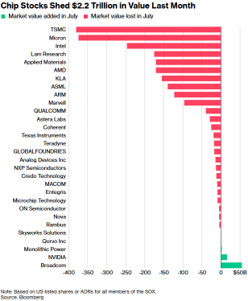
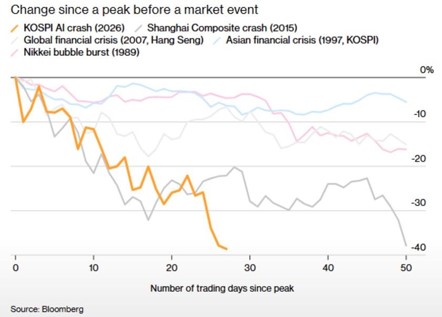
No single event caused the sell-off. Several worries arrived at once. Investors began comparing AI valuations to the dot-com bubble of 2000. A US interest rate hike suddenly looked more likely than expected. China reported genuine progress in advanced chipmaking, challenging assumptions of unchallenged US and Taiwanese dominance. And one major AI cloud provider flagged plans to resell its own spare computing capacity, which some investors read as an early sign of oversupply.
What turned a correction into a rout, though, was leverage. Many individual investors had borrowed large amounts of money to invest in AI and memory chip companies. A large, AI-focused hedge fund that had ridden concentrated bets on chip and memory stocks to extraordinary returns was forced to sell almost its entire portfolio after its lenders demanded more cash to cover mounting losses (a "margin call"). Selling of that size, at that speed, pushed prices down further than the news alone would suggest, a reminder that sharp market moves often say as much about who is being forced to sell as about what a company is actually worth.
It's worth remembering what didn't change. Samsung, TSMC and other chipmakers reported some of their strongest quarterly profits on record through this period, and semiconductor industry earnings overall grew well over 100 per cent year on year. Prices for renting AI computing power, a real-world gauge of demand rather than sentiment, kept climbing through the year rather than falling, and the contracts hyperscale cloud providers are signing for AI computing capacity have grown considerably more expensive too. If a genuine supply glut were emerging, we would expect the opposite.
Markets have already recovered much of the July losses, with US shares reaching fresh highs by mid-August. But the underlying tension hasn't gone away: enormous capital spending by a handful of companies, against still-modest revenue generated by AI products so far, a gap we flagged in an earlier note. At some point, spending and returns need to move closer together, and upcoming earnings from the largest chipmakers will be watched closely for evidence either way.
This looks like a violent repricing of expectations and a forced unwind of excess leverage, layered on top of a sector that remains, by the numbers, in genuinely strong shape. That combination can look and feel like the beginning of the end, even when it isn't. Concentration in a handful of AI-related names has made markets more sensitive to swings like this, which is exactly why a diversified portfolio, rather than a concentrated bet on any single theme, remains the more effective way to participate in whatever comes next.
The Investment & Research team at PSK are always monitoring market conditions and data points to ensure portfolios align with our overall long-term objectives. If you’d like to discuss any of the points raised, please contact your Adviser or call us on (02) 8365 8300.
General Advice Warning - Any advice included in this article has been prepared without taking into account your objectives, financial situation or needs. Before acting on the advice, you should consider whether it's appropriate to you, in light of your objectives, financial situation or needs.


